Automated Compliance
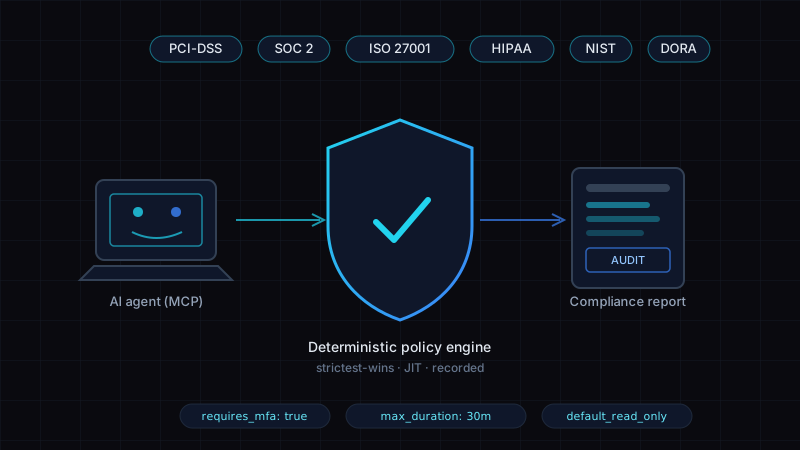
Compliance frameworks enforced as deterministic policy — PCI-DSS, SOC 2, ISO 27001, HIPAA, NIST, DORA — plus your own policies, your runbooks, and an MCP server so AI agents comply too.
The Compliance Problem
Auditors don't ask "do you have a PAM tool?" They ask "show me that nobody had standing access to production, that every privileged action was attributed to exactly one identity, and that access was time-boxed." Today, that answer usually lives in spreadsheets, screenshots, and hope — shared accounts, standing privileges, policies that are documented but never enforced.
PDAccess inverts the model. Compliance stops being a reporting exercise and becomes enforced behavior: every privileged session — human or AI agent — passes through a policy engine that applies the exact constraints your frameworks demand, deterministically, before the session is allowed to exist.
Frameworks Enforced Out of the Box
Six well-known frameworks ship with PDAccess as a platform-managed reference corpus. Each framework's authoritative clauses are indexed for RAG citation, and each maps to a set of deterministic constraints enforced at the tunnel and access proxy:
| Framework | Authoritative clauses | Default deterministic constraints |
|---|---|---|
| PCI-DSS v4.0.1 | Req 8.2.8 (15-min idle session timeout), Req 8.4.1–8.4.3 (MFA for all CDE & non-console admin access), Req 8.5.1 (no MFA bypass/replay), Req 10.2 (audit of all privileged actions) | MFA required · 15-min idle timeout · 30-min max duration · ticket ID required · read-only by default |
| SOC 2 (TSC) | CC6.1 (logical access security), CC6.2 (prior authorization), CC6.3 (least privilege & timely revocation), CC7.2 (system monitoring) | MFA required · approval required · 60-min max duration · zero standing privileges |
| ISO/IEC 27001:2022 | Annex A 5.15 (access control), 5.18 (access rights provisioning/revocation), 8.2 (privileged access rights), 8.15 (logging) | MFA required · event-based JIT · shared accounts blocked · session recording |
| HIPAA Security Rule | §164.312(a)(1) (access control & unique user ID), (a)(2)(iii) (automatic logoff), (b) (audit controls), (d) (authentication) | MFA required · unique actor attribution · 15-min idle timeout · full query audit |
| NIST CSF 2.0 | PR.AA-01 (identity management), PR.AA-02 (authentication & session management), PR.AA-03/04 (access control & permissions) | MFA required · event-based JIT · shared accounts blocked · session recording |
| DORA (EU 2022/2554) | Art. 6 (ICT risk governance), Art. 9(1)(b) (access control & asset classification), Art. 9(1)(d) (ICT incident management) | MFA required · approval required · 60-min max duration · unique actor attribution · full session audit |
Two notes on the last two:
- NIST — the platform corpus anchors on NIST CSF 2.0, and the technical docs include a cross-walk to NIST SP 800-53 Rev 5 controls (AC-2, AC-6, AC-17, AU-12, IA-2) for the buyers who ask for it.
- DORA — third-party ICT providers (Art. 30) get the same JIT treatment as your own staff: contractors and vendors can be scoped, time-boxed, and attributed just like internal users.
When a target falls under multiple frameworks, the engine applies the strictest constraint across every parameter — shortest max duration, shortest idle timeout, mandatory MFA, forced read-only. No interpretation, no gaps.
Your Policies, Your Rules
Frameworks are the floor, not the ceiling. PDAccess gives you a declarative rule builder for your own policies — every rule is deterministic, attached to targets, and enforced at the tunnel:
max_duration_minutes— hard cap on how long a JIT window lastsidle_timeout_minutes— sessions that go quiet get torn downrequires_ticket_id+ticket_regex_pattern— no access without a valid change ticketdefault_read_only— read-only by default, writes require an explicit request (mandatory for AI agents)allowed_protocols— restrict which protocols a target can be reached overrequires_mfa— MFA enforced per target, per policyapproval_mode—auto_approve,single_approver, ordual_custody
Bring Your Runbooks
Your standard operating procedures — the PDFs, wikis, and markdown files that describe how you operate — are ingested into a tenant-isolated RAG pipeline (CPU-only ONNX embedding and reranking; no external API calls, no data leaving your deployment). When someone asks "what's the process for a production database migration?", PDAccess answers with citations to your own runbooks. The same policy lookup is available to AI agents over MCP.
Built for AI Agents
The PDAccess MCP server exposes the compliance surface to your local coding agents:
list_accessible_targets— what the agent may touch, without exposing credentialslookup_compliance_policy— the active constraints on a target, cited to framework clauses and your SOPsrequest_jit_access— a policy-validated JIT request (MFA + approval, ticket checks)get_tunnel_status— live status of the agent's route leaserevoke_jit_access— close the window earlygenerate_compliance_report— audit-ready aggregation mapped to your active clauses
Agents get no standing access and cannot talk their way past policy: read-only by default, every action attributed to a named agent identity, every request recorded in the same audit trail as human access.
Audit-Ready, Multi-Tenant by Default
Every tenant's policies, SOP vectors, and audit logs are isolated with row-level security and tenant-scoped vector filtering. When the auditor comes, generate_compliance_report produces one report that maps deterministic proxy audit logs — MFA verification, human vs. agent traffic, full SQL/SSH transcripts — to the exact clauses of the frameworks you selected.
The Bottom Line
- Compliance is enforced in the proxy, not reported from a spreadsheet — constraints are applied before the session exists
- One policy engine covers six well-known frameworks plus your own rules — strictest wins, always
- Your runbooks become queryable, citable policy via RAG — no external APIs, nothing leaves your deployment
- AI agents comply by construction — the same MCP surface, the same policy, the same audit trail