Linux Host Security
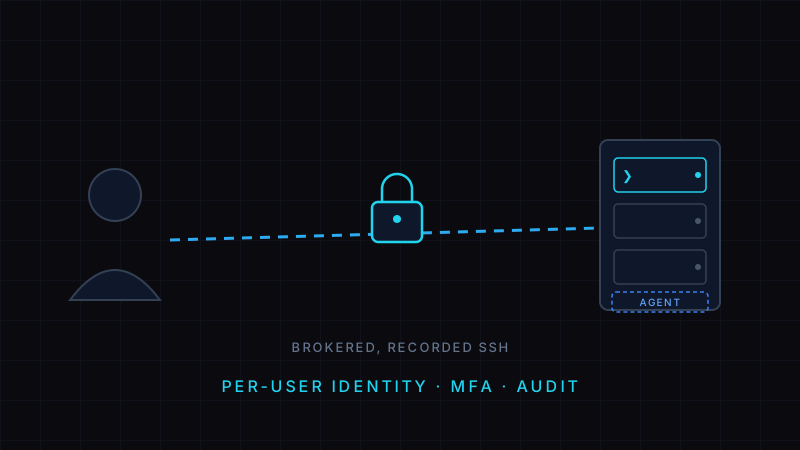
A lightweight Linux agent plus SSH brokering — per-user identity, forced MFA, command-level control, and recorded sessions on every Linux host.
The Linux Access Problem
Linux hosts are where production work actually runs — application servers, CI runners, database hosts, and the management planes in front of them. And they're often protected the way they were a decade ago: shared root and admin accounts, passwords sprawled across runbooks, SSH keys checked into repositories, and no per-user audit trail. When a host is compromised — or a key leaks — the blast radius is every host that key can reach, and the question "who was doing what, on which host, when?" has no clean answer.
The problem isn't the hosts. It's the identity model: shared credentials with no per-user accountability. PDAccess fixes this with a lightweight Linux agent and SSH brokering that puts a real, unique identity in front of every shell session.
The Linux Agent
The PDAccess Linux agent is a small, low-footprint daemon that runs on each host you want to protect:
- It enforces the access path — SSH sessions to the host are brokered through PDAccess, not through local shared accounts.
- It applies policy on the host — command-level controls and session policies are enforced where the work happens.
- It stays out of the way — one agent per host, low resource use, and unobtrusive in production and air-gapped environments alike.
The agent is the endpoint of the proxy model: the central platform brokers and records, the agent enforces, and raw credentials never sit on the host or with the user.
Per-User Identity and MFA for SSH
With PDAccess, per-user identity and MFA become first-class on every Linux host:
- No shared root — every engineer, contractor, and automation account has a unique identity; elevated actions are scoped by policy, not by who knows the password.
- Forced MFA — every SSH session authenticates individually and challenges multi-factor before a shell is handed over.
- Command-level control — a junior engineer gets read-only inspection; a senior engineer can manage services; a contractor is restricted to a defined window and a defined set of commands.
Role definitions and time boundaries apply the same way they do for network devices, databases, and the rest of the platform.
Eliminate Standing SSH Credentials
Standing SSH credentials — long-lived passwords, keys checked into repos, "just in case" access — are the root of most host compromise. PDAccess removes them:
- No long-lived keys on the host — access is brokered per session; there is nothing sitting on disk to leak.
- Automatic revocation — offboard someone and their identity stops working on every host immediately.
- Just-in-time for break-glass — emergency access is requested, approved, time-boxed, and recorded — then evaporates.
Recorded, Audited Host Sessions
Every session on every host is captured into a single, audit-ready record — user, host, command, and time:
- Full session recording — the complete text stream, replayable from start to finish.
- Incident attribution — exactly who ran what, where, and when.
- Compliance evidence — per-user accountability that meets PCI-DSS, SOX, and ISO 27001.
The Business Impact
Organizations using PDAccess for Linux host security achieve:
- Eliminated shared host credentials — no more
rootaccounts known to everyone - Per-user accountability — every shell session is identified, MFA-protected, and recorded
- Command-level control — least privilege enforced on every host
- Faster incident response — emergency access when you need it, gone when you don't
- Compliance-ready — audit trails that satisfy PCI-DSS, SOX, and ISO 27001
Bottom Line
Linux hosts deserve the same identity, MFA, and audit controls as your network and databases. PDAccess brings that to the host layer through a lightweight Linux agent and SSH brokering — replacing shared credentials with per-user identity, enforcing MFA, and recording every session. The same PAM model, extended to the machines where your work actually runs.
#PDAccess #PAM #Linux #SSH #HostSecurity #MFA #ZeroTrust #Compliance