Database Proxy
A policy-enforcing database proxy that brokers every SQL session — no shared credentials, every query recorded.
The Database Access Problem
Databases hold the most sensitive data in any organization — customer records, financial ledgers, credentials, and regulated content. Yet access is often managed the way it was twenty years ago: a handful of powerful credentials shared among developers, DBAs, and support staff, with no record of which query touched which data.
Shared passwords are the norm, privileges are broad by default, and queries go unrecorded — and when someone leaves, their database credentials keep working. PDAccess replaces that model with a database proxy: a broker that sits between every SQL client and your databases.
What a Database Proxy Is
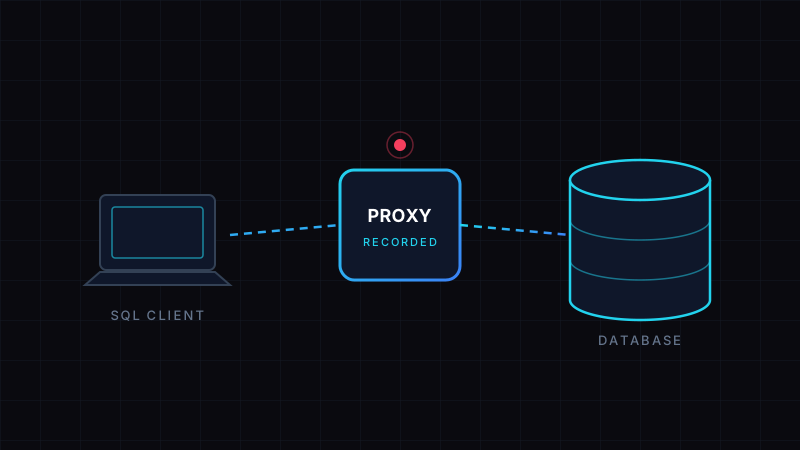
A database proxy is a transparent broker that sits in the path of SQL traffic. Clients connect to the proxy, not to the database; the proxy authenticates the user, injects the real credential behind the curtain, enforces policy, and records the session. To the database it looks like a normal connection, and to the user like their normal client — but to the organization it is the single control point where every query becomes attributable, policy-checked, and recorded.
- Native protocol access — the proxy speaks the SQL dialects your applications already use, so no bolt-on gateway breaks existing tooling.
- No client-side secrets — the SQL client authenticates to PDAccess, never to the database directly.
- Per-connection brokering — every session is brokered through the proxy, keeping the credential in the vault.
Why a Database Proxy Matters
A database proxy is not a convenience feature — it is the control that makes database access auditable and safe:
- It kills shared credentials. Every connection carries a real user identity. The database password lives in the vault, is injected behind the proxy, and never appears on a laptop, in a script, or in a chat message. "Everyone uses the dba_prod password" stops being true.
- It produces query-level audit evidence. Auditors and incident responders always ask: which user ran which query, on which database, at what time? A proxy answers that with a complete, searchable record — exactly what PCI-DSS, SOX, and HIPAA demand for data access.
- It enforces least privilege in practice. Policies scope each user to the schemas they own, can enforce read-only access, and can block dangerous statements. A developer sees only their application's data; a contractor gets one database for one window.
- It neutralizes insider risk and offboarding. A departing employee's database access is revoked the moment their account is — even if the underlying password is unchanged. And because every session is recorded, insider misuse is detectable, not just assumed.
- It removes plaintext secrets from the edge. CI pipelines, support tooling, and developer laptops no longer carry database passwords at all, shrinking the blast radius of any single compromised device.
How PDAccess's Database Proxy Works
PDAccess brokers database access through a native SQL proxy. Users connect with their usual SQL client; PDAccess routes every connection through its encrypted proxy, brokers the credential from the zero-knowledge vault, and records the session end to end.
- Zero-knowledge brokering — users never see the database password; it is injected behind the proxy and never exposed to the user, their laptop, or their tooling.
- Recorded queries — queries are captured and logged, so you can answer what was read, modified, or exported in any session.
- Automatic rotation — credentials rotate on a schedule without touching any user or application.
- Per-database policy — role definitions, time boundaries, and approval workflows apply the same way as for every other privileged protocol on the platform.
The Business Impact
Organizations using PDAccess's database proxy achieve:
- Eliminated shared database passwords — no more credentials known to half the team
- Complete query audit trails — every access is recorded, searchable, and attributable
- Faster compliance — one record satisfies PCI-DSS, SOX, and HIPAA data-access requirements
- Safe rotation — credentials rotate automatically without coordination or downtime
- Consistent policy — the same PAM model that governs hosts and networks governs your data
Bottom Line
Database access is the highest-stakes access you control, and it deserves controls that match it. PDAccess brokers every database connection through a native SQL proxy — with zero-knowledge credential brokering, recorded queries, and per-database policy — so your data stays protected, your credentials stay secret, and your auditors get a complete record.
#PDAccess #PAM #IAM #DatabaseSecurity #SQL #ZeroTrust #Compliance